Irradiance is Key for Realistic Test Results
Solar radiation is the primary weather factor in material degradation. Accurately simulating the solar spectrum is critical for realistic and precise laboratory weathering testing. The photons capable of initiating photochemical reactions are particularly important, and their energy increases as the radiation's wavelength decreases. Thus, the UV cut-on plays a significant role in each light source used for laboratory weathering.
To achieve realistic weathering test results, it is essential to match the lamp’s spectrum as closely as possible to the solar spectrum. Studies have consistently shown that using high-energy radiation (low wavelength UV) in weathering instruments, which is not present in realistic sunlight, can distort the aging processes and result in unrealistic test results.
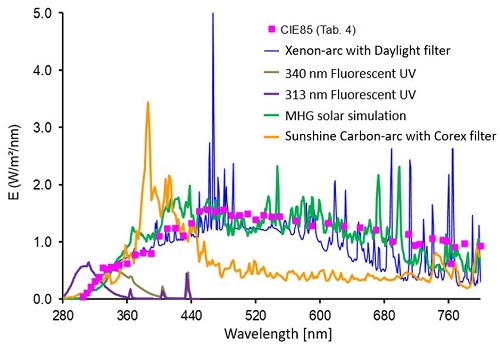 Light sources used for laboratory weathering
Reference Sun
In 1972, the International Commission on Illumination (CIE) published the first reference sun for testing purposes, specifying a realistic solar spectral power distribution for maximum acceleration, repeatability, and reproducibility. CIE updated its spectrum using advanced modeling and smaller steps in 1989. Since then, CIE Publication No. 85 Table 4 has served as the reference sun in weathering testing and as the target for laboratory light sources.
Keeping up with technical progress, Table 4 was recalculated at a higher resolution in 2014 and published as
CIE No. 241 in 2020.
 Solar spectrum outside atmosphere and at earth’s surface
Spectral Irradiance Specification in Testing Standards
Standards for weathering and lightfastness testing, such as ISO 4892, ASTM G55, or ISO 105-B02, typically prescribe specific UV wavelength intervals with tolerances to ensure reliable and accurate results. The primary spectra used in these standards are "Daylight" and "
Daylight behind Window Glass." To improve comparability and precision, a recent development has been the differentiation between
Daylight Type I and Type II. This distinction helps to further refine testing conditions and ensure that results are consistent and meaningful.
Various lamp-filter systems are now utilized to meet standard requirements, and tailored spectra are employed for specific applications, such as conditions inside cars or
retail stores.
More Information
To learn about all aspects of spectral irradiance distributions and reference spectra in weathering testing, a brand-new 21-page
Technical Guide is available for download. The Guide explains:
• Simulation of spectral requirements in laboratory weathering instruments
• Available light sources and filter systems
• Standard reference spectra
• New developments in weathering standards and applications
For further information on laboratory or outdoor weathering testing, check out our
online library, live educational calendar, or our library on
video tutorials and recorded online seminars.