A century ago, Thomas Alva Edison's light bulbs began to replace Atlas carbon-arc lighting systems. But during World War I, the German export blockade created new demand for Atlas lamps: not for lighting, but for testing materials. Instead of going out of business, Atlas adapted by “inventing” laboratory weathering.
Atlas Carbon-Arc Lamps for Stage Lighting
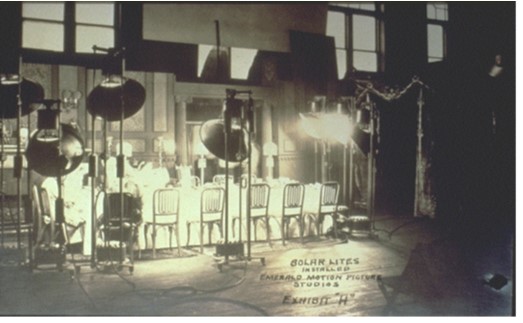
In the early 1900’s, Atlas Electric Company of Chicago manufactured Solar-Lite carbon-arc lamps used in photography studios, for exposing lithographic printing plates, and, the main business, for high-intensity stage lighting for theater or movie sets (above image).
Back then, Chicago was the motion picture capital of the US. Driven by the increased demand for outdoor sets, the movie industry prepared to move to Hollywood in the 1910’s.
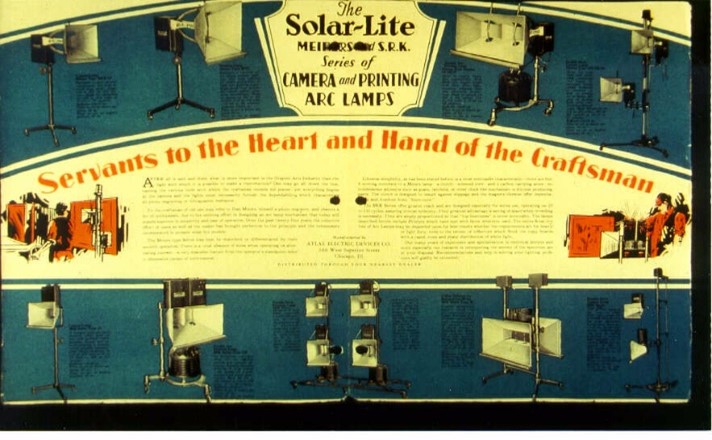
Atlas Solar-Lite carbon-arc lamps.
Edison’s Light Bulb Replaced Carbon-Arc
Prior to World War I, German manufacturers covered 85 % of the global demand for synthetic dyes. Accordingly, USA imported 90 % of their synthetic dyes, mostly from companies in Germany, e.g. BASF.
After World War I began, Britain initiated a trade blockade in the North Sea, cutting off Germany's global supply of aniline synthetic textile dyes. This compelled a shift back to less durable plant-based natural dyestuffs, which were more sensitive to UV light.
Color Fading Issue of Textiles
During this time, it was already known that Atlas’ Solar Lite carbon-arc lamps were able to bleach certain textile materials in stage sets, such as tablecloth, napkins, curtains, and costumes, quite similar to what the sun does.
Prompted by a significant problem with textile color fading, the Lowell Textile School, a prominent American institution, sought assistance from Atlas. They asked: Could carbon-arc lamps, which emit ultraviolet light, be employed to assess the lightfastness of textiles?

1915 Solar Determinator, 1919 Color Fade-Ometer, 1928 Weather-Ometer Model C
Solar Determinator and Color Fade-Ometer
In 1915, Atlas created the Solar Determinator as a proof of concept. Following approval from the US textile industry, the initial instrument was redesigned and launched in 1919 as the first commercial lightfastness tester, known as the Color Fade-Ometer.
Laboratory accelerated weathering was born.
More Information
Click here to listen to a recorded online seminar about history of weathering or laboratory weathering technology.
For further information have a look into our online library, listen to recorded online seminars or review upcoming online and on-site educational classes.