
Accelerated xenon-arc weathering testing is becoming increasingly vital for electronic products, as many are frequently exposed to the sunlight, heat, and moisture. Therefore, to ensure long-term durability and performance, laboratory weathering should be added to the existing stress tests against temperature and humidity, power cycling, electrical load, mechanical shock, vibration, corrosion, UV exposure, and more.
The Combined Effect
Xenon weathering testing is more than sole UV testing. Xenon weathering combines full-spectrum (UV+VISIBLE+IR) solar simulation together with heat, and moisture. Thus, enabling a “complete” environmental test instead of UV only.
UV initiates photo-induced degradation processes of polymers. Temperature drives the speed of following chemical polymer degradation pathways. Moisture further contributes to the degradation by lowering polymer glass transition temperature Tg, which impacts the level of O2 diffusion. Additionally, hydrolysis reactions take place. Finally, water can also cause mechanical stress. It happens through surface expansion during water uptake (rain or dew), and surface contractions when surfaces dry up again.
Remember, all three major weathering factors work synergistically! Therefore, weathering is useful when you seek a “complete” and realistic climatic stress test.
The Real World Only Faster
The good thing about weathering: once you have a good simulation of the worst-case climatic stress condition for your product (worst case region/climate for the intended use), we support you intensifying your weathering test towards maximum acceleration compared to real time degradation. Test method IEC 60068-2-5: Simulated solar radiation at ground level and guidance for solar radiation testing and weathering is typically a good starting point.
Depending on the product and intended use, typical acceleration factors are in the range of 5-30 times faster than real time.
Rotating Rack and Flatbed Xenon Instruments
Atlas lines of xenon weathering instruments:
• The Ci-series Weather-Ometer® are in widest use for consumer electronics testing, especially flat products, and displays of diverse sizes. All Ci models feature a single high-powered xenon-arc lamp, a large rotating test specimen rack for maximum exposure uniformity, and water sprays.
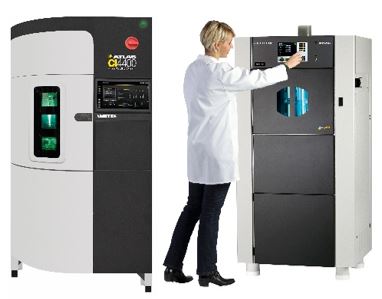
Ci4400 Weather-Ometer and Xenotest 440
• The Xenotest® series are more compact designed lower lamp power rotating rack instruments. Typically preferred when larger Ci capacities are not needed.
• The SUNTEST® line provide static horizontal test trays. They compromise on exposure uniformity. However, especially the SUNTEST XXL+ can accept extra-large, more three-dimensional test specimens, such as VR goggles and the like.
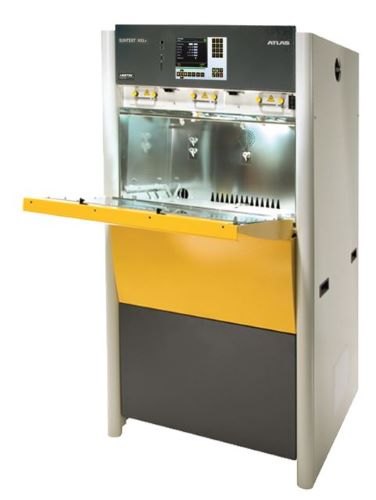
SUNTEST XXL+
More Information
Do not hesitate to contact us to discuss your testing needs.
For a deeper view into weathering and protostability testing of electronics and wearables listen to a 1-hour recorded webinar. You may also be interested in learning more about options and limitations for acceleration when performing weathering tests.
For further information on weathering technology, standards, and applications, check out our archive of almost 80 weathering blog posts, have a look into our online library, view videos, tutorials, and recorded webinars or register for educational classes.