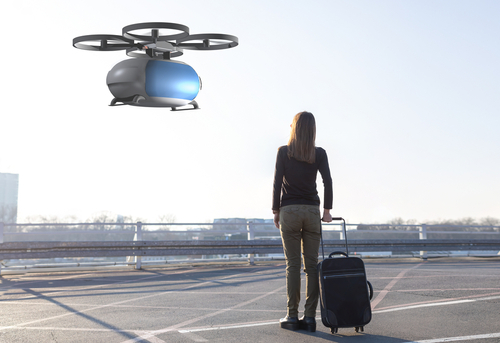
The rapidly evolving market for electrical aircraft, quadrocopters, drones, etc. is served by many new players and start-ups. Not everybody may be familiar with environmental durability and weathering testing, required to ensure proper lifetime of materials, components, and end products. This post provides guidance for industry-proven weathering and solar environmental testing.
Transportation Drones for People
The market for eVTOL (electric Vertical Take-Off and Landing aircraft) drones for people, often also referred to as quadrocopters or air taxis, is highly attractive. Its growth is majorly driven by advanced technology adopted from modern cars, and the demand for innovative transportation solutions.
Major companies involved are newer players like Vertical aerospace, EHang, Volocopter, Lilium, and Elevate. Also traditional aerospace companies like Boeing (acquired Wisk in 2023), Delta (contracted with Joby Aviation), and Airbus, as well as automotive OEMs such as Daimler, Stellantis (cooperating with Archer Aviation), and Hyundai (cooperating with Supernal) are active.
Obviously, eVTOL product development can benefit from modern automotive technology in terms of time and cost savings, compared to more expensive aviation technology used to build classic helicopters.
Laboratory Xenon-Arc Weathering at Automotive/Aerospace OEM
For decades, Atlas has been a strong partner of worldwide automotive and aerospace OEMs when it comes to their weathering testing protocols including xenon-arc testing.
Every new product development starts with xenon-arc weathering testing to select the right materials for the individual components – no matter if it is a new car, plane, or new quadrocopter. The weathering of exterior parts often involves using xenon-arc rotating rack devices such as Atlas Ci Weather-Ometers. It serves to determine which protective coating formulation best withstands sunlight-UV, heat, and moisture to the manufacturer’s standards (e.g. ASTM D7869, SAE J2527). The same applies for all interior parts exposed to sunlight, as well (e.g. ISO 105-B06, SAE J2412).
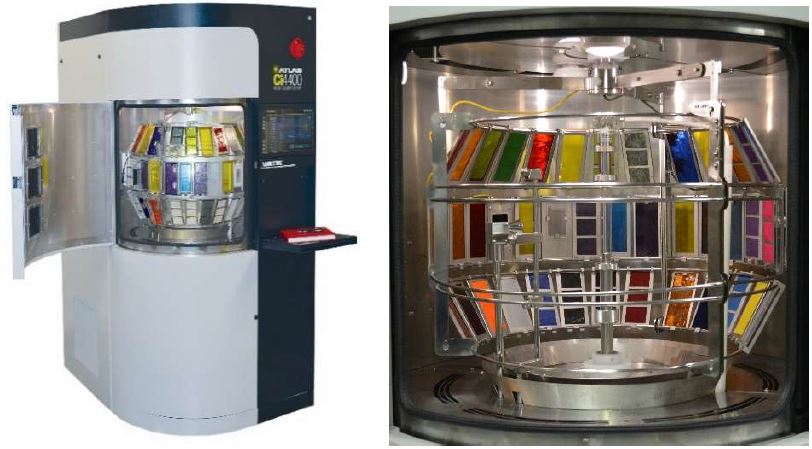
Atlas Ci4400 Weather-Ometer® xenon-arc weathering instrument with a rotating rack
Laboratory Solar Environmental Testing
While xenon-arc weathering testing addresses the right amount of UV-durability, further testing is required for studying, and finally guaranteeing, the safe performance and functioning of the entire quadrocopter. This is especially true for the functioning of all avionics and electronics under realistic worst-case conditions. Furthermore, the functioning of emergency or protective features, as well as the interior climate and light management (AC, electrochromic glazing, etc.…) supporting passenger comfort, is also tested.
These tests require flexible large scale solar environmental test chambers that can realistically replicate worst-case scenario conditions. These large-scale systems typically have a design that allows for simulation of solar days and longer term realistic extreme solar testing such as described in MIL-STD-810H procedures I and II, or special custom-designed drive-in solar environmental chambers, originally developed for cars.
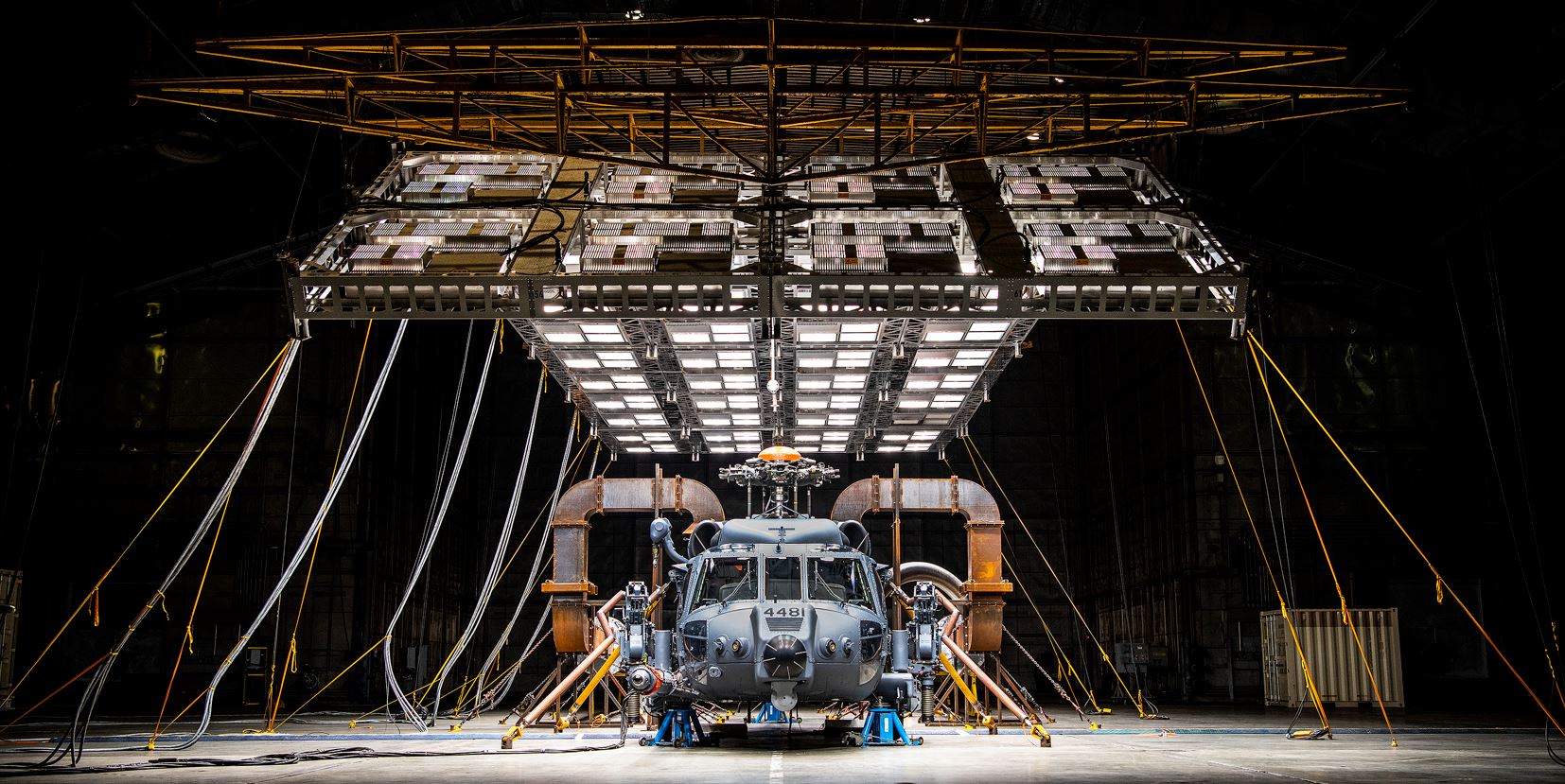
Large scale Atlas solar simulator used for solar heat load testing of a military helicopter against MIL-STD-810H (photo by Samuel King Jr.)
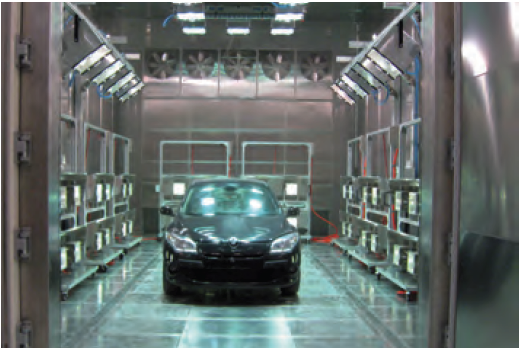
Custom-designed drive-in solar environmental test chamber with 180° surround Atlas solar simulator
More Information
Do not hesitate to contact us to discuss your needs and requirements. To learn more about weathering testing of coatings, plastics, or automotive parts please check out our online library or review upcoming educational classes. If you are interested in solar environmental testing, please have a look at our Standards Guide on this topic.