 Accelerated Xenon-Arc Weathering and Its Limits
Before we dive into the topic, we need to briefly recap a few basics about xenon-arc weathering. Without a doubt, xenon-arc weathering is one of the most valuable tools to determine product durability and service-lifetime. Xenon-arc acceleration, i.e., the factor of how much faster the test is compared to real-life, is usually between 10 and 20 – which does not satisfy everyone’s expectations.
Why is the acceleration limited? Basically, because xenon-arc testing typically mimics natural exposure conditions majorly in a time-compressed way. Water is applied in periodic cycles supporting realistic chemistry and adds mechanical stress that increases acceleration. When xenon-arc testing is further intensified for higher acceleration (degradation rates), then normally through only slightly increased UV-irradiance levels above natural maximum.
Additionally, when it comes to evaluating xenon-arc weathering results, the focus usually is on macroscopic property changes, for example color change, gloss loss, yellowing, or cracking. Xenon-arc testing, and simultaneous natural exposures can be time consuming until macroscopic changes or failures occur in a defined size or proportion (pass-fail criteria). This is particularly true for products with very long lifetimes such as PV-modules or building materials.
Benefits of High Irradiance and Focus on the Molecular Processes
In addition to xenon-arc weathering, the French National Center for Evaluation of Photoprotection (CNEP) in Clermont-Ferrand developed an ultra-accelerated photoaging technique that takes into account the molecular evolution. Atlas and CNEP jointly developed an instrument, now in its 3rd generation: SEPAP (Service de Photovieillissement Accéléré des Polymères). The originality is the quantitative observation of the generated photodegradation products over time and simultaneous reduction of light/UV stabilizers (antioxidant). Suitable analytical tools are FTIR and UV/VIS spectroscopies.
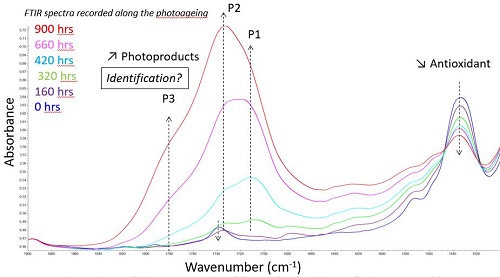 FTIR analysis of an accelerated photoaging SEPAP test of a UV-stabilized polymer over 900 h, monitoring degradation products P1-3 and simultaneous antioxidant (stabilizer) reduction. Image courtesy of CNEP.
Experienced users like the CNEP researchers are able to determine the critical degradation product (CP). A “CP” is always related to a specific property change. The CNEP team studies the critical level of a CP and – with their expertise - estimate the lifetime of a polymer within relatively short time. Ten years of ageing in natural conditions can be achieved in 42 days under ultra-accelerated conditions in SEPAP MHE for polyolefins materials.
It can be said, SEPAP MHE/MHE+ is an attractive tool next to xenon-arc weathering. Particularly useful for polymer researchers and polymer/additive manufacturers to quickly screen and compare new products.
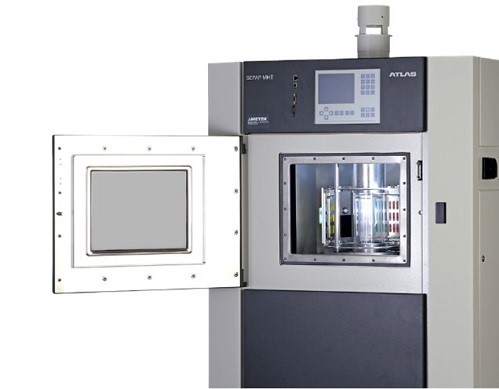 Atlas SEPAP MHE
Which Light Source is Used?
Atlas SEPAP MHE
Which Light Source is Used?
SEPAP uses 1000 Watt medium pressure mercury lamps. The lamps offer a stable line spectrum for about 1000 hours in the UV and VIS range (5 lines in the UV, 4 in the visible range). An optical filter avoids unrealistic radiation below 295 nm. Furthermore, very low contents of heat radiation allow for high irradiance testing at 90 W/m² (290-420 nm) at moderate 60°C BST for medium acceleration and up to 300 W/m² (290-420 nm) and 80°C BST for ultra-acceleration. Note, above mentioned irradiance levels are approximately 1.5 to 5 times higher compared to standard xenon-arc weathering.
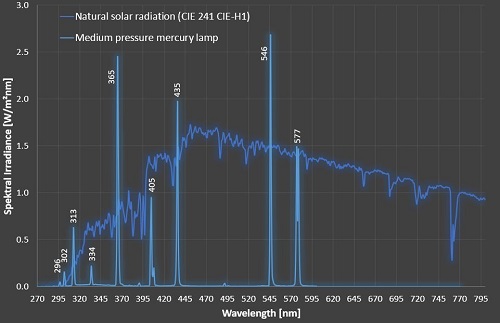 Spectrum comparison medium pressure mercury lamp vs natural solar radiation
Atlas SEPAP Background
CNEP researchers already conducted photoaging experiments back in the 1980s using mercury light sources. The idea of integrating mercury lighting into a test chamber as compact as a xenon-arc weathering chamber however was first realized in 1999 (SEPAP 12/24).
The latest generation, Atlas SEPAP MHE/MHE+, was introduced in 2014. It was developed in cooperation with CNEP and greatly supported by Renault, PSA and Polyone. The goal: reproduction of the degradation process of naturally ageing polymers in a further accelerated manner by an extended irradiance range and improved precision.
More Information
Review the SEPAP technology and download SEPAP MHE/MHE+ brochure.
Listen to recorded seminars on acceleration in laboratory weathering and outdoor testing with EMMAQUA.
Stay tuned: During the next weeks we will publish on our website a recorded online seminar specifically on the SEPAP method and technology.