
In Part II of our blog post series on basic weathering concepts, we explored the correlation between different tests. Now, we will shift our focus to the correlation between multiple runs of the same test method. This can be achieved by either repeating the test method using the same instrument (repeatability) or performing it across different instruments (reproducibility). Both scenarios fall under the umbrella of precision, a crucial factor in ensuring the reliability and consistency of results from repeated or reproduced weathering tests.
Precision, Accuracy, Trueness
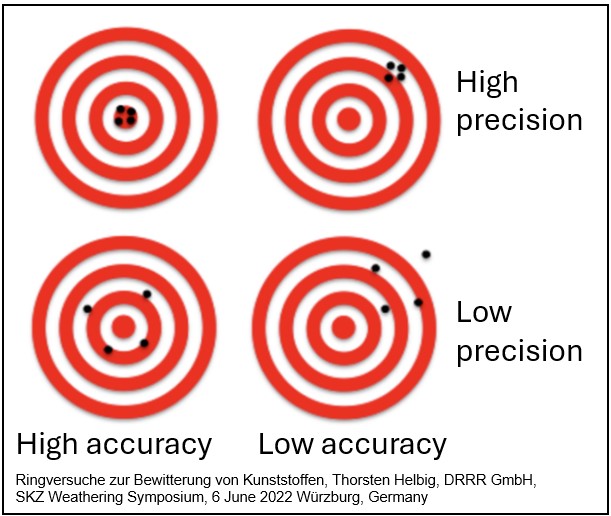
Accuracy and precision are two measures of observational error. Accuracy is how close a given set of measurements are to their “true value”. Precision is how close the measurements are to each other.ISO 5725-1:2023 defines a related measure: Trueness, "the closeness of agreement between thearithmetic mean of a large number of test results and the true or accepted reference value."
Precision describes random errors (a measure of statistical variability). The most common definition of accuracy relates to systematic errors (statistical bias). In this definition accuracy is independent from precision. A particular set of data can be said to be accurate, precise, both, or neither. This concept corresponds to ISO's trueness.
“True Value” in Weathering?
In laboratory accelerated weathering, the key question is: What is the true or accurate test result? Or in other words: the “real” test result? Traditionally, the “real value” has been determined through “real-world” testing. Typically, “real” reference data are obtained from “real-time” natural weather aging data, either produced at generally accepted standard outdoor exposure locations or by field tests. The two major benchmark locations for natural weathering, providing the reference conditions for many applications, are:
•
South Florida for subtropical testing, since SFTS was established in 1931,
•
Phoenix, Arizona for desert testing, since DSET was established in 1948.
The correlation between laboratory accelerated weathering and natural exposures is reviewed in the context of correlation and will not be discussed here. Our focus will be solely on precision.

Atlas Desert Sun Exposure Testing (DSET) facility in Phoenix, AZ
Repeatability and Reproducibility
Precision of a specific laboratory weathering test (e.g. ASTM G155 Cycle 1) includes two main aspects:
•
Repeatability refers to the consistency of the test results when the same operator uses the same equipment to run the specified test under the same conditions over a short period of time. It is a measure of the test method's reliability with a single weathering instruments.
•
Reproducibility refers to the consistency of test results when different operators use different equipment to run the specified test in the same or in different laboratories over a longer period of time. It measures the test method's reliability across different weathering instruments.
Measurement of Precision
ISO 5725-2 specifies the measurement of precision of a specific test method, i.e. repeatability and reproducibility. Two criteria give an indication if the test result is within an acceptable range:
•
Repeatability Limit: The maximum difference expected between two test results obtained with the same instrument. It provides a benchmark for evaluating the precision of a test method run in a specific weathering instrument.
•
Reproducibility Limit: The maximum difference expected between two test results obtained in different instruments. This limit helps in assessing the precision of a test method across different weathering instruments.
It must be noted that both repeatability and reproducibility do not depend on the instrument(s) only. Other important factors for precision are:
• Laboratory conditions
• Setpoints of parameters not specified in the test method (e.g. relative humidity)
• Tolerances of test parameters allowed in the test method
• Calibration and maintenance of the instrument
• Water quality
• Material properties and specimen preparation
• Specimen evaluation method
Interlaboratory Studies and Agencies
A weathering testing laboratory can independently determine the repeatability limit for their specific test methods, instruments, and materials by conducting consecutive tests in accordance with ISO 5725-2. Reproducibility limits for specific test methods are usually determined through interlaboratory studies (ILS), also known as “round-robin studies” or “proficiency testing”.
Typically, the organizing party prepares identical specimens and sends them to the participating laboratories, along with detailed instructions for testing, evaluating, and handling the specimens. In some cases, the individual laboratories only perform the exposure, while the evaluations are conducted by the organizer. In other instances, the evaluation of specimens by individual laboratories is included as part of the assessment.
In some cases, standard-developing committees or industry associations (e.g., FGIA, ASTM, ISO, VDA) collaborate with their members to organize and conduct interlaboratory studies. More commonly, professional, specialized, certified agencies provide this service to the industry. Here are two examples of such organizations:
•
Collaborative Testing Services, Inc., Sterling, VA, USA
•
German Reference Office for Proficiency testing and Reference materials (DRRR)
More Information
For exact definitions and detailed guidance, please refer to:
• ISO 5725-1:2023-07 Accuracy (trueness and precision) of measurement methods and results - Part 1: General principles and definition
• ISO/DIS 5725-2:2024-10 Accuracy (trueness and precision) of measurement methods and results - Part 2: Basic method for the determination of repeatability and reproducibility of a standard measurement method (revision of version dated 2019-12)
Listen to recorded webinars on differences between weathering instruments, correlation, reference materials or service life prediction.
For further information on laboratory or outdoor weathering testing, check out our online library, upcoming educational classes, or other recorded online seminars.