
Accelerated weathering, light fastness, UV test, photo stability, ASLT … Are these just different words for the same test? Or do they actually indicate different combinations of different stress factors, and therefore different test methods?
The key to understanding differences and similarities is the application. Different industries, e. g. pharmaceutical, paint, PV, or textile manufacturers use different language. Over the years, they have developed individual testing philosophies adapted to their materials, end-use application and product life time expectations. Consequently, the relevant standards developing committees wrote tailored test methods using this industry-specific terminology.
Different Words and Different Worlds
Specific terminology has been derived from different historical roots: from photography, electronics, chemistry, or material engineering. For instance, in 1919 a laboratory instrument for accelerated colorfastness to light – the so-called “Atlas Fade-Ometer” - was developed in Chicago, tailored to the needs of the textile industry. The first outdoor weathering test on contruction coatings was performed in 1906 in North Dakota, USA.
To structure the vast field of environmental durability testing, the main applications can be divided into five "application clusters" as shown in the figure below in different colors:
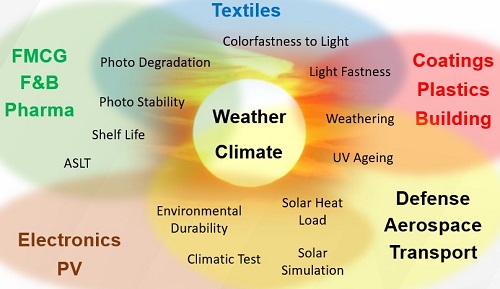
Weather and climate are the same for all, but pretty much everything else is different.
Weathering, Lightfastness, UV, Solar Stress Test
In order to understand the differences between tests, one must compare test parameters and cycles in detail. For example, as shown in the table below, it becomes obvious that a lightfastness test is a “weathering test behind window glass without rain”. And a “UV test” is simulating only a small portion of the solar spectrum and therefore cannot be classified as a fully capable weathering test.

More Information
A brand-new online seminar explains how different industries developed individual environmental ageing tests, philosophies, and terminology, tailored to their needs, materials, and user expectations.
Explore the Atlas Knowledge Center for instrument tutorials, recorded online seminars, technical documents, and a training schedule.