 Introduction
Microplastics can be found everywhere in our environment, yet we still have a limited understanding of how they break down into even smaller fragments and how fast they degrade. This knowledge gap is crucial for accurately assessing both their destiny and the consequences of their presence.
Hence, Dr. Patrizia Pfohl et al have designed a test protocol for investigating the degradation of microplastics under simulated outdoor sunlight conditions. The following is a summary of their publication.
Degradation Testing Using the SUNTEST
The degradation study used the SUNTEST XLS+ as a temperature controlled solar simulator.
- Daylight filter
- Irradiance 60 W/m2 (300-400 nm)
- Black Standard Temperature 65 °C
3 x 1000 hour exposures were applied on TPU esters and ethers (aliphatic, aromatic) and PA-6 microplastics. During each of 3 x 1000 h irradiation steps, the SUNTEST provided 216 MJ/m2 of UV radiant exposure.
Each 1000 h step equals about one year outdoor mid-European solar exposure.
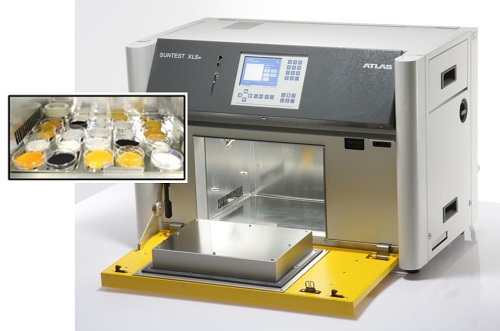
Atlas SUNTEST XLS+
UV-Durability
Each 1000-hour interval was thoroughly examined both qualitatively and quantitatively to assess the degradation products that were produced. “Depending on the polymer nature, UV aging of primary microplastics leads to different aging.” Highly impressive, the insights into the degradation mechanisms of the different TPU samples. They observed radical formation, auto-oxidation, chain cleavage, possible chain scissions, involved photo-Fries rearrangements, and the formation of carboxylic acids and primary amines as degradation products.
Observed UV durability of the four tested TPUs:
TPU_ester_ali > TPU_ether_ali > TPU_ester_arom > TPU_ether_arom
UV-Exposure Dependant Evolution of Micro- and Nanoplastic Fragments
The dose-dependent evolution of micro- and nanoplastic fragment release was recorded as a function of UV aging over the course of the 3x1000 h steps. Differing from earlier studies on macroplastic degradation, the release increased roughly linearly with the UV radiant exposure and did not show the lag time before fragmentation, as observed on macroscopics.
For PA-6, there was an increase in released micro- and nanoplastic fragments until 2000 h UV exposure. At 3000 h, the release of 1 μm particles reduced almost to the value of the pristine material, which implies further transformation of the previously formed detachable small particles in dissolved organics or volatile species before sampling. TPU_ether_arom showed a reduced release of nanoplastic fragments after 3000 h of UV aging compared to 2000 h of UV aging.
More Information
Atlas thanks to the entire R&D team around Dr. Pfohl for their exceptional contributions to the study of microplastics. Read the entire publication here:
Learn more about the SUNTEST series for controlled solar exposures of polymers and more.