
Water is often considered a secondary factor in laboratory weathering testing, but its purity is critical to achieving reliable results and preserving the integrity of your equipment. By investing in proper water purification and adhering to industry standards, you can ensure that your tests yield accurate, reproducible outcomes while avoiding costly equipment damage.
General Insights from Industry Standards
The importance of water purity is clearly highlighted in ISO 4892-1 “Xenon Weathering of Plastics.” According to this standard:
"For xenon-arc instruments, the purity of the water used for spraying the specimens is very important. Without proper treatment to remove cations, anions, organics, and, in particular, silica, exposed specimens will develop spots or stains that do not occur in exterior exposures."
It is important to note that the use of water with excessive silica impurities (greater than 0.1 ppm) has the potential to not only harm your specimens but also damage the test chamber's reflectors and its optical filters. Silica deposits on specimens or test chamber components manifest as small spots that are very difficult to remove. In the worst case, test chamber reflectors and/or optical filters require replacement.
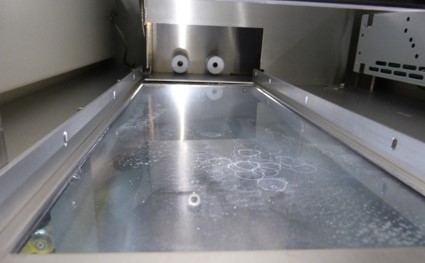
Irreversible silica deposits on optical base filter inside SUNTEST
As stated in both ISO 4892-1 and ASTM G151 improper water quality can furthermore lead to discrepancies between your laboratory weathering test and natural outdoor exposure (see correlation).
Practical Advice for Ensuring Water Purity
To maintain the integrity of your tests and protect your xenon-arc equipment, it’s essential to implement an effective water purification system. The following advice will help you achieve the required water quality:
•Choose the Right Purification Methods: A combination of deionization and reverse osmosis is often the most efficient way to produce water that meets the stringent demands of laboratory weathering testing.
•Monitor Key Parameters: Ensure your purified water adheres to these specifications:
• pH value: 6-8
• Conductivity: < 5 µS/cm
• Dissolved solids: < 1 ppm
• Silica: < 0.1 ppm
Regularly monitoring these parameters will help you maintain consistent water quality and avoid unnecessary risks to your tests and equipment.
More Information
For guidance on proper weathering testing,contact us, have a look at our library, or review upcoming educational events.