 Image courtesy of EYE Applied Optix
Metal Halide “Super-UV” or “Super Accelerated” Technology
The concept of using powerful metal halide (MH) light sources in a weathering device goes back to the mid 1980ies. Since the MH based testers were able to deliver >20 times the natural UV irradiance, they were soon promoted as “super-UV” or “super accelerated” testers.The first MH super-UV device was sold in Japan in 1984. Until today, Japan remains the major “super UV” market supplied by Japanese manufacturers SUGA and IWASAKI.
The MH light sources used for super-UV devices provide a continuous spectrum with a relatively short-wavelength cut-on in the UV at about 280 nm. Furthermore, the spectrum is limited to the UV wavelength region plus some near visible light up to 450 nm. There is practically no emission of IR heat radiation.
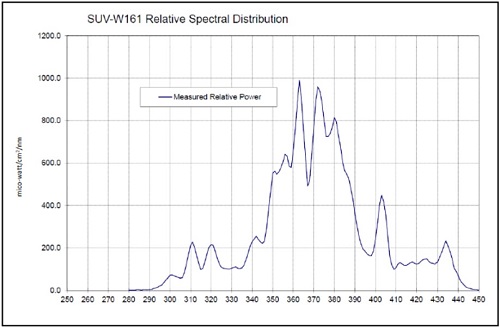
MH super-UV spectral irradiance 280-450 nm (Image courtesy of EYE Applied Optix)
Use and Limitations of Super-UV
Super-UV is a powerful UV-durability screening device but not a weathering instrument. Super-UV so far has been reported a suitable tool for accelerated vinyl film degradation. Similar like Fluorescent UV devices, it may have further potential as a fast tool for polymer resin screening against their tendency to UV-induced chalking.
However, natural and laboratory weathering relies heavily on three primary factors, which create a synergistic effect:
• Radiation
• Temperature and
• Moisture
While the degradation rate is not solely determined by the formation of as many as possible photo-induced radicals, super-UV testing is kind of condemned to frequently lack correlation with natural exposure results.
Irradiance Level and Spectral Distribution
After decades of weathering testing majorly done using full spectrum xenon-arc technology, we see that intensification of irradiance in a laboratory test works well up to a factor of about 2 compared to natural maximum. Therefore, intensified irradiance levels today typically are in the range of 90-120 W/m2 (300-400 nm). We have also learned that laboratory weathering better avoids unrealistic radiation below 295 nm. Today, we classify optical
Daylight filters in Type I and II, dependent how well they match the natural 295 nm UV cut-on wavelength as well as the entire UV. It seems like only a little imperfectness when super-UV cuts on at ~280 nm, but it can negatively affect correlation to natural degradation.
 Comparison of UV irradiance (300-400 nm) levels
Cyclic Water Spray and Time of Wetness
Additionally, cyclic water spray is important for achieving well correlating laboratory weathering tests. Critical are sufficiently long wet times and their applied frequency. If done right, the water impact supports realistic degradation effects, and the cyclic mechanical stress can contribute to the speed of testing. However, for super-UV testing, where the test duration is shortened to several days, there is no way of achieving the required wet times and required wet/dry frequency.
Surface Temperature
Finally, getting the surface test temperature right is a matter particularly for colored products. The importance of realistic visible and IR radiation for realistic heat build-up from white to black surfaces. Certainly, a strength of xenon-arc weathering and another weakness of super-UV.
As a general take-away from above discussion: materials and failure types (color change, cracking, delamination, etc…) strongly influenced by factors other than UV radiation will not likely be good candidates for super-UV testing. Xenon-arc weathering though often limited regarding short test durations is still the best available laboratory technique that covers all materials and failure types.
More Information
Download a white paper on high irradiance testing or view a recorded seminar on acceleration in weathering testing.
Browse the Atlas knowledge center for video tutorials, recorded online seminars, technical guides, and a seminar calendar.