
In weathering testing, correlation usually measures how well an accelerated test predicts a material's property change in “real-world” environmental conditions over time. But correlation without relevance is meaningless: in addition to the macroscopic property change, the degradation mechanism on molecular level needs to be the same in both tests.
Acceleration, correlation, causality, reciprocity – these are important concepts used in weathering testing. To avoid costly mistakes in weathering testing one should understand these basic principles. In this new series of blog posts, the most important technical terms are explained, and further information material is recommended.
Correlation and Relevance
There are two main reasons why correlation is important:
• If helps to determine how well a laboratory weathering test simulates natural conditions, such as UV radiation, temperature fluctuations, moisture, and other environmental factors.
• To ensure that test results provide meaningful insights into a material's long-term durability. This allows manufacturers to determine real-world product durability with sufficient accuracy.
In our context, correlation addresses the ability of two types of tests to produce an equivalent property change for a specific material. Usually, this compares an accelerated outdoor or laboratory weathering test to either static outdoor weathering or some specific end-use condition. If the underlying cause of the property change is the same, or if one parameter is the cause for the other one, both tests are not only correlating – they are then also relevant to each other.
Correlation
• is the quantitative, mathematical (statistical) relationship between weathering results achieved with two different tests;
• is usually measured using macroscopic properties and determined with statistical methods.
Relevance
• is a qualitative assessment to find out if the “cause”, e.g. the chemical degradation pathway is the same in both tests;
• is investigated using microscopic, molecular, chemical properties, applying analytical methods.
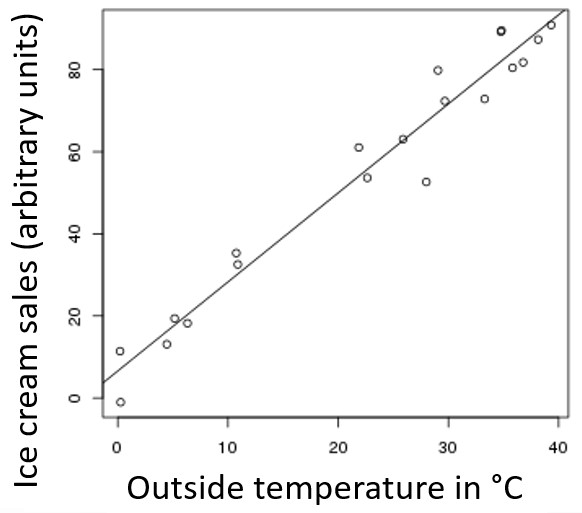
Ice cream sales and air temperature at a certain point in time show a relevant correlation. Obviously, the higher the temperature, the more ice cream is sold. Temperature is the cause for ice cream sales.
Pseudo-Correlation
Sometimes, two data sets “correlate” to each other without sharing the same cause. The correlation appears purely by accident. We see “pseudo-correlation.
The annual harvest of red cabbage in Germany correlates well to the points of the lowest scoring team in the German football league. These data sets neither share the same cause, nor is one the cause of the other. A perfect example of non-relevant “pseudo correlation”.

Measurement of Correlation
I more technical terms: Correlation is a statistical measure that expresses the extent to which two variables are linearly related. Correlation does not imply causation, meaning that even if two variables are correlated, one does not necessarily cause the other.
Correlation is often represented by a correlation coefficient (r), which ranges from -1 to 1. 1 would be perfect correlation, 0 would be completely statistical data distribution and -1 would be a perfect negative correlation. A good correlation is typically considered for a correlation coefficient between 1 and 0.6, depending on the number of data points.
Pearson correlation evaluates the strength and direction of a linear relationship between two variables. It is suitable when the data are normally distributed and the relationship is expected to be linear.
Spearman (rank) correlation, on the other hand, measures the strength and direction of a monotonic relationship, which means one variable consistently increases or decreases with the other, but not necessarily in a linear way. Unlike Pearson, Spearman ranks the data before evaluating the relationship, making it more robust to outliers.
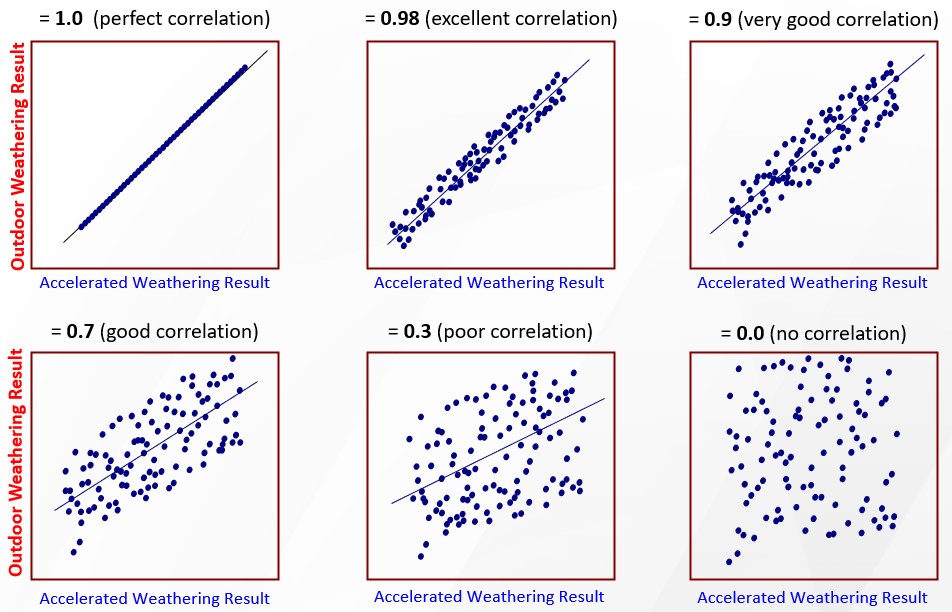 Pearson Correlation Coefficient
If you would like to learn more about Pearson and Spearman correlation coefficients, we recommend a recorded webinar on that topic.
Limits of Correlation
Basic international standards ISO 4892-1 and ASTM G151 include an annex discussing factors that may decrease correlation of an accelerated weathering test to real world performance:
• Short wavelength exposure
• Spectral distribution with high deviation from solar radiation
• High irradiance exposure
• Continuous exposure to light
• Unrealistic specimen temperatures
• Unrealistic or non-existent temperature cycling
• Unrealistic or non-existent moisture delivery
• Water quality used
Correlation depends on the material, the accelerated test method, the real-world conditions, and the evaluation parameter (property change). For a good correlation to real world weathering, in other words a relevant accelerated weathering test method, it is essential to reproduce the ageing effects in a realistic manner.
Learnings
Understanding and ensuring correlation and relevance in weathering testing improves the reliability of an accelerated test. Reliability that research and engineering teams need to determine real-world product durability with sufficient accuracy.
In addition, selecting the right (= correlating and relevant) test method, understanding statistical methods (Pearson and Spearman) to measure correlation, and addressing testing limitations is essential to achieve meaningful weathering results.
More Information
To learn more, listen to recorded webinars on correlation, reference materials or service life prediction.
For further information on laboratory or outdoor weathering testing, check out our online library, upcoming educational classes, or other recorded online seminars.
For those of you wanting to dig deeper, we recommend selected literature and key weathering conferences.