
Weathering is the adverse response of a material or product to the factors of weather, often causing unwanted and premature product failures. Consumers spend billions of dollars per year to maintain products that inevitably degrade and to replace products that fail. Materials that fail as a result of exposure to outdoor environments account for a significant portion of this total cost.
Factors of Weather(ing)
The three primary factors of weathering are solar radiation (irradiance level and spectrum), heat, and water (moisture). These factors, in conjunction with oxygen and secondary effects such as airborne pollutants, biological phenomena, and acid rain, act together to cause “weathering.”
Primary weather factors are simulated in accelerated laboratory weathering instruments. Secondary factors account for considerable weather degradation as well, but are simulated in dedicated instruments such as salt-fog chambers, dust testing chambers, immersion devices, etc.
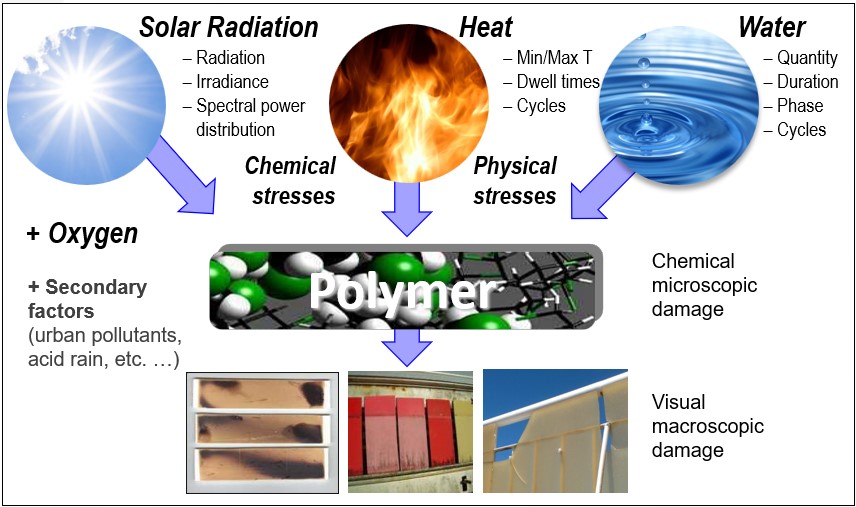 Primary and secondary weather factors
Weather
Weather is defined as the physical state of the atmosphere at a specific point in time or in a shorter period of time in a specific location or area, as it is characterized by the meteorological elements and their interaction.
Weather parameters such as cloud cover, wind speed, air temperature or solar UV can be measured. Atlas Weather Summary Reports provide a valuable free database for historical weather data.
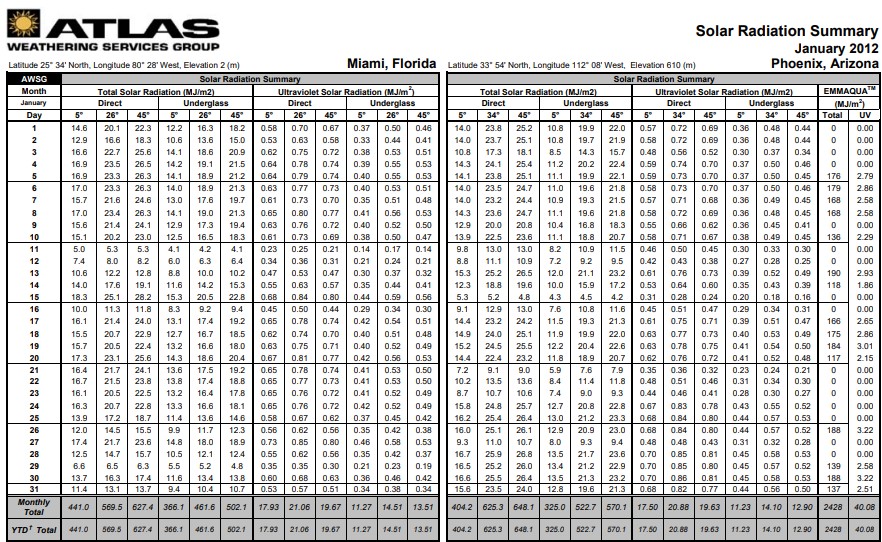
Example for an Atlas Weather Summary Report
Climate
Climate is defined as the summary of the weather phenomena that characterize the average state of the atmosphere in a certain place or in a more or less large area. In general, a period of 30 years is used to calculate averages. The selected period is called climate reference period.
Climate is described by statistics, such as means and extremes of temperature, precipitation, and other variables, and by the intensity, frequency, and duration of weather events. Climate parameters cannot be directly measured. They must be calculated from long-term weather data.
The most commonly used classification of climates on earth is the Köppen-Geiger map, which is public domain and can be found on the internet.
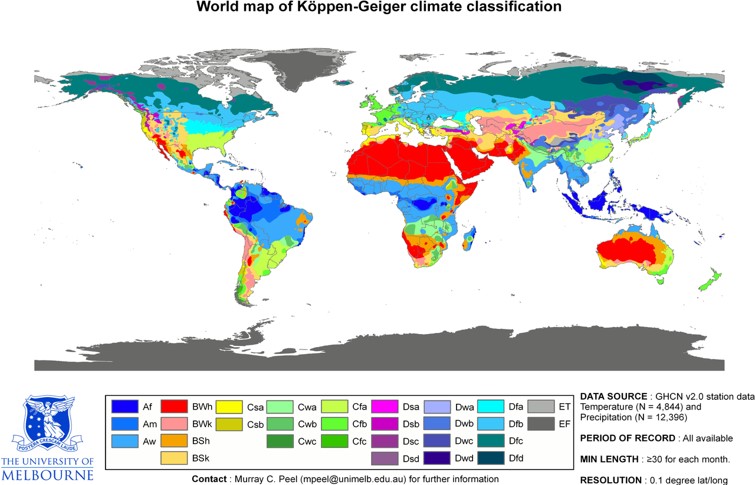 Köppen-Geiger classification of climate zones upon their seasonal weather patterns.
Climate Change
Do we have to adjust weathering test methods due to climate change?
Test parameters like surface temperature or irradiance may not need to change because these are at the realistic worst-case level already for most weathering test methods. Climate change will affect the average but not the maximum values. Nevertheless, test cycles may have to be adjusted, e.g. to account for higher or lower water stress. Test durations also may have to be assessed to maintain the relation of accumulated stresses between laboratory test and outdoor exposure.
In addition, specific environmental test programs may need to be adjusted to account for changing environmental conditions. A classical example is a study from 2013 saying that climatic change will make commercial shipping possible over the North Pole by the middle of the century. This may lead to more low-temperature and freeze-thaw testing of electrical components installed on those ships, such as radar.
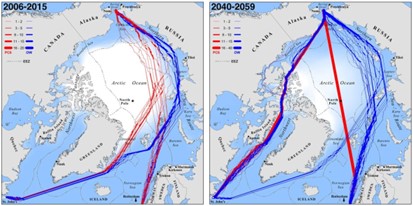 Climatic change may open new ship routes in the arctic. From study published in NPAS
More Information
For further information on laboratory or outdoor weathering testing, check out our online library, upcoming educational classes, or other recorded online seminars.