
There are two different ISO standards for weathering testing of textiles. This article explains the differences between ISO 105-B04 and B10 and provides guidance on which one to use for which application.
First Revision of ISO 105-B04 for 30 Years
The 5th edition of ISO 105-B04 (2024) was just published. The previous edition ISO 105-B04 (1994) was very open with the test parameters. The focus of the current revision was to keep the same requirements, but to provide recommended parameter settings for better reproducibility and repeatability of testing. A summary of the test parameters can be found in the Table.
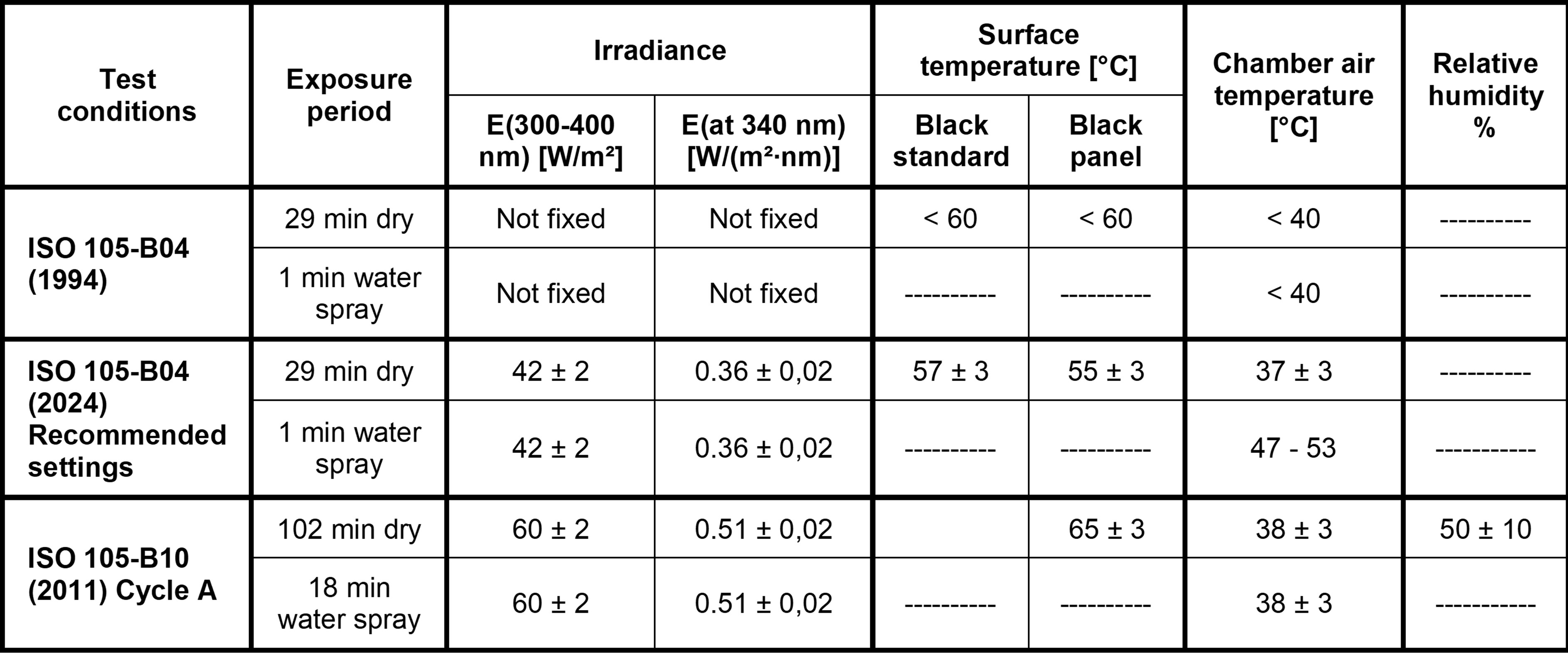 Test parameters of ISO 105-B04 (1994), ISO 105-B04 (2024), and ISO 105-B10 (2011).
Which Filter Type to Use?
ISO 105-B04 requires the use of daylight filters, but these have been vaguely defined in earlier editions: transmission of 0% between 290 nm and 300 nm, rising to at least 90% between 380 and 750 nm. This was a little misleading, so sometimes testing was incorrectly performed with window glass filters. The definition has now been clarified in ISO 105-B04 (2024) and harmonized with ISO 4892-2, ISO 16474-2, and ASTM G155. Now spectral irradiance and not just filter transmission is clearly defined. Both, Daylight filter Type I and Type II are allowed. Test results may differ using Type I or Type II filters. In the past, using different filter types for ISO 105-B04 sometimes led to inconsistent test results. It is strongly recommended to compare test results only if they were generated with the same filter system, i.e. Type I or Type II. Therefore, it must be stated in the test report which type was used.
When to Use ISO 105-B04 or ISO 105-B10?
It can be confusing that there are two very similar textile weathering standards for color fastness testing of textiles:
• ISO 105-B04 (2024) Colour fastness to artificial weathering: Xenon-arc fading lamp test
• ISO 105-B10 (2011) Artificial weathering - Exposure to filtered xenon-arc radiation
ISO 105-B04 originates from lightfastness testing of textiles and uses relatively mild test parameters. It is commonly used for apparel and similar applications, which are not permanently exposed in an outdoor environment. It is mostly relevant when color is the main evaluation criteria, and it can be used to assign lightfastness ratings. ISO 105-B04 uses the blue wool scale as a reference. The blue wool references need to be protected from water during the spray phase of the test cycle. This requires special specimen holders with window glass cover, but only for the blue wools.
 Blue Wool specimen holders for ISO 105-B04 with glass cover. Left: for Ci Weather-Ometers. Right: For Xenotest instruments.
ISO 105-B10 originates from plastics and coatings testing. Here the long-term performance of technical textiles in outdoor environments is relevant. The main evaluation criteria are often physical parameters such as tensile strength. ISO 105-B10 does not use the blue wool scale. Instead of a
• 1 minute spray as in ISO 105-B04, ISO 105-B10 specifies:
• 18 minutes spray for normal conditions
• 30 minutes spray for humid conditions.
B10 also uses a higher irradiances level and higher temperatures. Together, this provides a higher stress level to technical textiles (architectural textiles, boat covers, tents and shades), which is more representative of permanent outdoor exposure.
Other Standardization Activities
ISO 105-B10 (2011) got reapproved in 2022 for another five years. Like AATCC TM169 “Weather Resistance of Textiles: Xenon Lamp Exposure” (2020), ISO 105-B10 offers additional test conditions for extreme climates, such as hot humid and hot dry climates. ISO 105-B10 defines general daylight filters but does not differentiate between type I and type II. It is likely that the daylight requirements will be harmonized with ISO 105-B04 in its next revision.
More Information
Listen to our recorded online seminars on textile testing and weathering test setup.
For further information have a look into our online library, listen to recorded online seminars or review upcoming online and on-site educational classes.