
Electrochromic glazing, also known as smart windows or dynamic glass, represent a revolutionary advancement in building as well as transportation technology. These innovative glass panels dynamically adjust their transparency from clear to tinted (or opaque) in response to low voltage. As a result, they offer improved energy efficiency, user comfort, or enhanced privacy by press of a button.
Examples in transportation are the Boeing 787-8 Dreamliner windows, or the Ferrari Superamerica with its electrochromic glass roof. Examples in buildings are the Nashville Int. airport in Tennessee, or the Norther Central college in Illinois.
Design and Functionality
The heart of electrochromic windows is the electrochromic layer construction that changes transmittance when subjected to an electric voltage. (Common materials include tungsten oxide and nickel oxide for the active layers). The electrochromic layer is typically integrated into the window's glazing system as shown on in the graphic. Finally, the top layer of the outside facing window can come with a UV-reflective coating - a nice feature that minimizes the amount of harmful UV entering through “normal” windows.
Prior to the launch of each new smart glass product, durability testing needs to be done against heat and solar radiation stress.
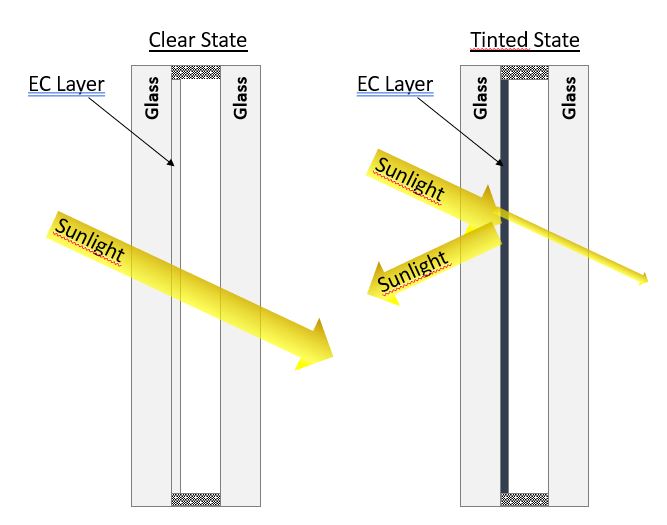
Schematic design of a smart window in building, switchable between clear and tinted state via EC layer
ISO 18543 and ASTM E2141 for Accelerated Aging Testing
Both ASTM E2141 and ISO 18543 provide means for evaluating the durability of electrochromic glazings. Since the two standards are majorly identical, we can focus on the international standard. Note that the test methods are not applicable to other chromogenic glazings such as photochromic and thermochromic glazings.
ISO 18543 describes two tests including 3 steps:
• STEP 1,3: switching cycles clear/tinted without light
• STEP 2: switching cycles clear/tinted under solar exposure (AM 1.5) and high temperatures
STEP 2 test conditions:
• Irradiance (at 300-3000 nm): 1000 ±40 W/m2 and homogeneity ≤8 % at the exposure area
• Surface temperature at the centre of the test specimen: approx. 85 °C (tinted state)
• Chamber air temperature: approx. 40 °C have shown to support ~85 °C surface temperature
• Test duration: 5000 hours; 50.000 switching cycles clear/tinted
Water-cooled xenon-arc (6500 W) technology using near IR-absorbing filter combination such as Quartz/CIRA is described as suitable solar simulation.
More Information
Due to the diverse range of specimen sizes and individual specific requirements, setting up the ideal laboratory test can pose a challenge. However, in line with this trending application, our team is eager to help and support. Do not hesitate to discuss your needs and requirements with our experts.
For further information on laboratory or outdoor weathering testing, check out our online library, educational calendar, or recorded online seminars.