 Heat, water, and solar radiation are the primary weather factors. To simulate solar radiation in weathering instruments through properly filtered light sources, two parameters are key:
Spectral power distribution
Irradiance (E)
The Sun - A Few Facts
Our sun is a massive, nearly perfect sphere of hot plasma, heated by nuclear fusion reactions in its core.
Its distance from Earth defines the “astronomical unit” (about 150 million kilometers or about 8 light minutes).
Roughly three-quarters of the sun’s mass consists of hydrogen, the rest is mostly helium.
The sun's core reaches about 15 million degrees Celsius, driving nuclear fusion. The surface (photosphere) is around 5,500 degrees Celsius.
Planck's law of radiation describes how the intensity of electromagnetic radiation emitted by a “black body” varies with frequency or wavelength at a given temperature. For the sun, which approximates a black body at about 6000 Kelvin, Planck's law helps predict the spectrum of light it emits, with the peak intensity in the visible light range. Most life forms on Earth rely on this 'peak range' (visible spectrum) for energy conversion or orientation, such as in photosynthesis or vision.
Reference Spectral Power Distribution
Simulating the spectrum of global (= direct plus diffuse) solar radiation on earth’s surface, aka “daylight spectrum”, in a reproducible way, a well-defined reference sun is required.
In 1972, the International Commission on Illumination (CIE) standardized the first reference sun in its Publication No. 20. To achieve worst-case solar radiation for maximum acceleration, CIE No. 20 specifies equatorial sun at noon in the time of equinox, cloudless sky and well-defined content of ozone, water vapour, and aerosols in the atmosphere.
In 1989, using advanced modelling techniques, CIE publication No. 85 updated the reference sun with smaller wavelength steps and provided more accurate data compared to CIE No. 20. Until now, almost all ISO and most national weathering standards refer to the solar benchmark spectrum given in Table 4 of CIE No. 85, with the following parameters:
Sea level
Relative air mass: 1
Water vapour content: 1.42 cm precipitable water
Ozone content: 0.34 cm at standard temperature and pressure (STP), 0°C, 1 atmosphere
Spectral optical depth of aerosol extinction (at 500 nm): 0.1
Ground reflectance: 0.2

Solar Spectrum at Earth’s Surface
Reference Irradiance Level
According to CIE No. 20, the total global irradiance in the wavelength region that is reaching the earth’s surface (290 nm - 3000 nm) is 1,120 W/m². CIE No. 20 subtracts an estimated 10 % radiation contribution from the surroundings, and therefore recommends for the purpose of material testing in weathering instruments:
Simulation of the relative solar spectral power distribution as good as technically possible, and
Applying an irradiance level of 1,000 W/m² on sample surface in the total wavelength region of solar radiation from 290 nm to 3,000 nm.
CIE No. 85 does not contain a recommendation for the irradiance level for testing purposes. Therefore, the recommendation in CIE No. 20 for a total irradiance of 1000 W/m² is still used.
Using this irradiance value, the following E levels for Daylight conditions (xenon with daylight filters) with a cut-on wavelength at about 300 nm can be calculated from the spectrum in CIE No. 85 Table 4:
550 W/m² in the UV + VIS wavelength region (wide band, 300 nm - 800 nm), and
60 W/m² in the UV (broad band, 300 nm – 400 nm).
Most ISO and derived national standards have been using the same wide band irradiance level of 550 W/m² also for Daylight behind window glass conditions, but because of the longer-wavelength cut-on at about 320 nm, the UV irradiance is approximately 10 W/m2 lower:
550 W/m² in the UV + VIS wavelength region (wide band, 300 nm - 800 nm), and
50 W/m² in the UV (broad band, 300 nm – 400 nm).
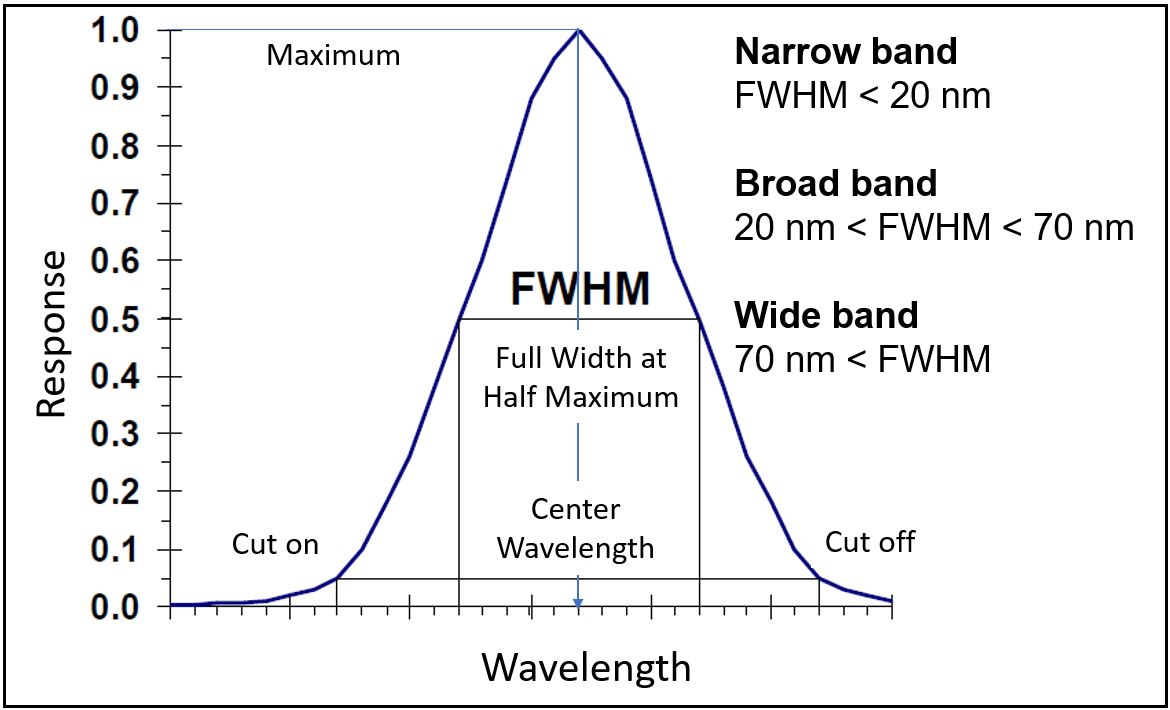
Narrow Band, Broad Band, and Wide Band, as defined in ISO 9370
Narrow Band Irradiance
Since most photochemical degradation happens in the UV, most modern standards, e.g. ISO 4892-2 and ISO 16474-2, specify irradiance levels either broad band (300 nm - 400 nm), as above, or narrow band at 340 nm (Daylight) or 420 nm (Daylight behind window glass):
0.51 W/(m2nm) at 340 nm (typical ratio used in most xenon-arc standards)
1.10 to 1.25 W/(m²nm) at 420 nm
(typical ratios used in most xenon-arc standards, depending on type of window glass filters)
Narrow band irradiance values are difficult to calculate from CIE No. 85, as it specifies data in 5 nm steps around 340 nm, and 10 nm steps around 420 nm.
Today, wide band irradiance control (300 nm – 800 nm) is only specified in a few standards and continuously replaced by narrow band or broad band control.
Recent Developments
In 2014, CIE Publication No. 85 Table 4 was recalculated with a higher resolution and published as Technical Report ISO/TR 17801. Another complete recalculation was published as CIE No. 241 in 2020, which since then has been served as the standard reference solar spectrum for weathering purposes.
More Information
For those of you who want to dig deeper:
Blog post on new standard reference sun CIE 241 & CIE-H1
Blog post on how much UV reaches the earth’s surface
Guide on irradiance and radiant energy in weathering testing
For additional information have a look into our online library, listen to recorded online seminars or review upcoming educational classes.