
Acceleration factors cannot be calculated. They must be measured.
Acceleration, correlation, causality, reciprocity – these are important concepts used in weathering testing. To select the right test method, understand limitations and options, and avoid costly mistakes one should know what these basic principles mean. In a new series of blog posts, the most important technical terms are explained and further information material is recommended.
Accelerated Ageing
The three primary weather factors solar radiation, heat, and water, in conjunction with atmospheric oxygen and secondary factors, induce microscopic chemical and physical ageing processes. With time, these accumulate into changes of macroscopic properties (e.g. color change), and finally lead to product failure.
In accelerated weathering instruments, the primary factors are simulated at worst-case – and sometimes intensified - level, to accelerate the natural weather ageing processes. Using appropriate testing standards, laboratory weathering delivers information about the degradation of a material or product earlier than in real life. The “Acceleration Factor” tells you how much earlier.
Acceleration Factor
An “Acceleration Factor” – short AF – is the time required in a specific outdoor weathering test (test 1) to induce a certain property change of a defined specimen, divided by the time needed for the same change of a replicate specimen in an accelerated laboratory weathering test (test 2).
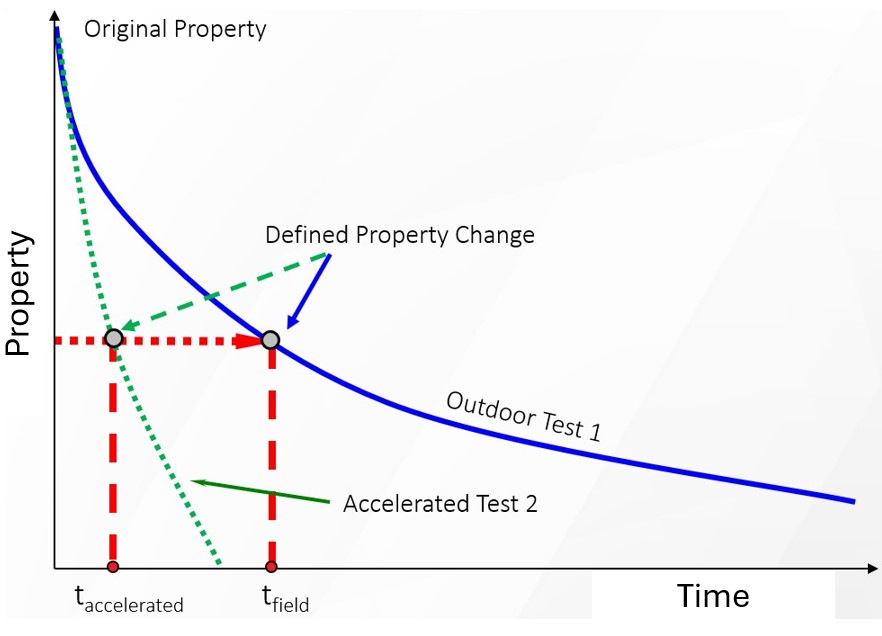
The diagram shows the ageing curve of a specific property, blue for test 1 (field) and dotted green for test 2 (accelerated). The horizontal dotted red line is a specific property change, e.g. the pass-fail criterium. Vertical red lines for taccelerated and tfield are the times which the exposed specimen needs to reach the defined property change.
AF = tfield / taccelerated
Important: The AF is not determined by comparing accumulated environmental stresses, e.g. radiant exposure, in tests 1 and 2. The AF always refers to responses of replicate materials in the two tests. In addition, the AF can be different for different properties of interest.
Therefore, AF cannot be calculated. It is specific not only to the two tests compared but also to the material itself and the property of interest.
How To Accelerate
In all accelerated testing, not just weathering, we have two options for acceleration: time compression and intensification (see VDI 3958).
Time compression means that those periods with little impact on degradation, e.g. nights, cold winter days, or cloudy skies, are eliminated and replaced by continuous, often cyclic, worst-case conditions. Maximum irradiance at peak sun and daily high temperatures deliver maximum weather ageing stress. Most basic laboratory weathering test methods, such as the common ASTM, ISO, or SAE standards, are based on time compression.
Intensification of parameters is more difficult. To learn more, listen to a recorded webinar on acceleration. Here is a summary of options:
• Short wavelength radiation, below natural UV-cut on:
Not recommended. Impact of high-energy photons which are not present in solar radiation at earth’s surface result in unrealistic, and therefore useless, results.
• Level of spectral irradiance
Increasing temperature accelerates chemical reactions. It is important to stay clear of transition temperatures, such as glass transition or melting temperature, for the specific material under test.
• Level of temperature
Irradiance can be increased with certain limits while maintaining the correct spectral power distribution if
reciprocity is met.
• Temperature cycles
Thermo-mechanical stresses can be intensified, and therefore ageing accelerated, by increasing the stress frequency and/or amplitude. Our
webinar on acceleration describes models which can be applied.
• Relative humidity
Usually not used for acceleration. Nevertheless, a realistic relative humidity level is required for correlating and precise test results.
• Dry/wet cycles
Amplitude and frequency/duration of water stress, e.g. through spray or immersion, plays an important role in weather ageing of many materials.
ASTM D7869 on transportation coatings significantly increased the water stress to saturate specimens to a level observed outdoors, and therefore reach realistic results.
Limits of Acceleration
Various processes involved in weather ageing happen simultaneously: absorption of solar photons, forming of radicals, chemical reactions, diffusion and migration, water uptake, erosion, etc. But: they run on very different time scales.
Some factors, like irradiance or temperature can easily be increased, accelerating photon absorption and reaction rates – other processes are difficult to accelerate, e.g. water uptake or diffusion. Therefore, one must be careful with intensification to keep a realistic balance of weather stresses.
Learnings
Acceleration Factors (AF) cannot be calculated, they must be measured. Calculating the relation between stress levels of a non-accelerated test and an accelerated test, e.g. by counting photons or comparing temperature levels, does not result in an AF. It only gives an indication about the potential range of expected acceleration.
More Information
To learn more, listen to recorded webinars on acceleration, terminology, time scales, or reciprocity. Or download a white paper on high irradiance testing.
For further information on laboratory or outdoor weathering testing, check out our online library, upcoming educational classes, or other recorded online seminars.
For those of you wanting to dig deeper, we recommend selected literature and key weathering conferences.